



Intro
The Court of Appeal has ruled in favour of Thatchers in the latest, and most significant, decision involving copycat products and packaging. Now that the dust has settled, we can consider what these means for brand owners and copycats.
By finding against Aldi, the Court has reaffirmed how brand owners can successfully make a claim against businesses based on registered trade mark rights in well-known packaging where the copycat product brings to mind the brand owner's packaging.
Given the current economic climate and prevalence of copycats, lookalikes, and dupes on the market, this is a welcome decision for brand owners.
Current market conditions
This decision takes place in a different economic environment to earlier copycat/ lookalike product cases. The cost-of-living pressure has meant that more and more consumers visit discount supermarkets as part of their weekly shopping, with price being an important factor in decision making. There is also a differing attitude towards brands with the rise of social media influencers legitimising copycat products with comparison videos promoting the 'dupe' culture.
Brand owners also face the prospect of a social media backlash when bringing proceedings against supermarkets because they are sometimes incorrectly considered to be the corporate giant taking on an underdog. There are commercial relationships in place which make any legal action by brand owners unpalatable, with a prospective defendant likely to be a potential or existing stockist of the brand.
These factors have contributed to favourable market conditions for discount supermarkets to sail close to the wind and even cross the Rubicon when it comes to copycat packaging, by infringing brand owners’ intellectual property and taking unfair advantage of the investment made by brands in their products.
The danger of this continuing being that brand owners will have no incentive to invest in new innovative products and will no longer be able to compete in the market place. Branded products will slowly be replaced by own-label versions and the level of choice that the consumer has at present will gradually decrease.
Passing off - the original copycat product infringement claim
Early copycat cases were brought under passing off as brands rarely registered rights for whole packaging and copycats avoided using the dominant element of any registered marks making conventional trade mark infringement claims unlikely to succeed.
Succeeding in a lookalike case based on the Likelihood of Confusion (section 10(2) Trade Marks Act (“TMA”) is notoriously difficult as it is hard to show that consumers genuinely mistake one product for another. This is particularly the case for Aldi that does not stock a number of brands that it imitates and can argue that consumers are fully aware of where they are buying their products.
Since Jif Lemon there have been very few cases which have been able to successfully establish the classical trinity of passing off (goodwill, misrepresentation, and damage), with the exception being Numatic (which concerned the get up of the vacuum cleaner – a colourful base with a black top). In these cases, the claimants were able to show that the public had been sufficiently educated to recognise their products by features other than trade marks (which were not on the infringing products) and as a result provide evidence that the relevant public was deceived.
Moroccanoil was the well known case in which passing off failed, in part on the basis that the relevant public is unlikely to disregard a distinctive name and in that instance the get-up plays a lesser role.
The Thatchers Court of Appeal decision
Thatchers dropped its claims of passing off and trade mark infringement based on the Likelihood of Confusion for its Appeal and only appealed grounds related to its Reputation claim. The Thatchers Court of Appeal decision does not change the law, but it does clarify that the best way for brand owners to tackle copycat packaging is likely to be through registered trade mark protection.
Section 10(3) TMA as amended by regulation 7 of the Trade Marks (Proof of Use, etc.) Regulations 2004 (SI 2004/946) provides:
“(3) A person infringes a registered trade mark if he uses in the course of trade, in relation to goods or services, a sign which—
(a) is identical with or similar to the trade mark,
where the trade mark has a reputation in the United Kingdom and the use of the sign, being without due cause, takes unfair advantage of, or is detrimental to, the distinctive character or the repute of the trade mark.”
Thatchers relied on UK Registered Trade Mark No. 3489711 for the device shown below, registered in respect of “cider; alcoholic beverages, except beer” in Class 33 with effect from 14 May 2020 (the “Trade Mark”):


The key factors to establish for a successful 10(3) claim of unfair advantage are set out below in reference to the relevant paragraphs of the decision.
Registered Trade Mark Protection; What is the Sign; Similarity of the Trade Mark and the Sign, Reputation in the Trade Mark; Link Evidence; Intention; Unfair Advantage.
In this decision Lord Justice Arnold sets out the key parts of the s.10(3) TMA test and how they have been met by Thatchers:
In my judgment Thatchers is correct that the present case is squarely within the Court of Justice’s description in L’Oréal v Bellure at [41] and [49] of “a transfer of the image of the mark” and “riding on the coat-tails of that mark”.
This is noteworthy, not least because Aldi argued that the Court of Appeal should depart from this case law, but also because it reminds brand owners that this is the type of case that they need to bring in order to be successful.
Registered Trade Marks
Thatchers had registered a whole packaging trade mark (the “Trade Mark”) for the can of cider so it was clear what rights they were relying on.
What is the Sign?
The first step in any trade mark infringement action is to identify the relevant infringing sign. Thatchers struggled with this at first instance and the judge found counsel for Thatchers' submissions to be contradictory and confusing. This will have wasted precious time at in the IPEC trial and should be avoided with a clear set of Particulars of Claim.
Arnold LJ set out that the Sign is "the graphics on the cans and on the cardboard 4-can pack" of the Aldi Product, not the Aldi Product itself. This was favourable to Thatchers and was the natural comparison between the Registered Trade Mark and the infringement.
Reputation
The judge at first instance found that the Trade Mark had a reputation by the date when the Sign was first used – this was evidenced by sales. This was not challenged by Aldi.
Link evidence
At first instance HHJ Melissa Clarke also found that the average consumer would have made a link between the Sign and the Trade Mark.
Para 114: As explained in paragraph 92 above, that has at least evidential relevance. Furthermore, it is clear from the social media evidence referred to by the judge at [118] that at least some consumers received the intended message loud and clear. There is no reason to think that they were atypical.
This element of the judgment shows how useful social media evidence can be in a 10(3) case. Whilst it can be hard to find evidence of actual confusion, social media is a suitable forum to find evidence of a link in the mind of the consumer and in this case there were sufficient instances to show that a portion of the relevant public saw a link between the products.
Intention by Aldi
Thatchers were able to provide useful context from market research on lemon-flavoured alcoholic and non-alcoholic beverages. These products show how it is possible to convey the message that a product is lemon flavoured without coming close to the market leading product, or the Trade Mark. This was mentioned by Arnold later in the decision.
These are the relevant lemon products:
It was also clear that the Infringing Sign departed from the Aldi house style (which was apparently inspired by the packaging for Strongbow).
Para 99: …it is entirely possible to convey the message that a beverage is lemon-flavoured without such a close resemblance, and therefore the resemblance cannot be coincidental. …The inescapable conclusion is that Aldi intended the Sign to remind consumers of the Trade Mark. This can only have been in order to convey the message that the Aldi Product was like the Thatchers Product, only cheaper.
Para 114:… it is clear that Aldi intended the Sign to remind consumers of the Trade Mark in order to convey the message that the Aldi Product was like the Thatchers Product, only cheaper. To that extent Aldi intended to take advantage of the reputation of the Trade Mark in order to assist it to sell the Aldi Product.
The Taurus range:
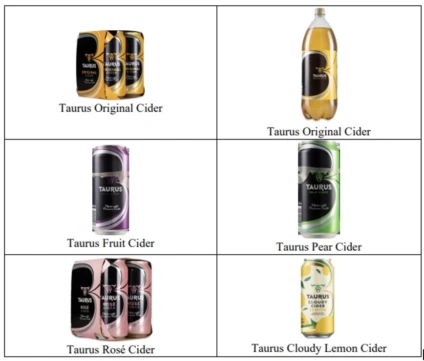
By being able to show the intention of Aldi, Thatchers was able to build its argument relating to unfair advantage as Thatchers were able to show that Aldi intended the Sign to remind consumers of the Trade Mark and as a result intended to take advantage of the reputation of the trade mark.
Evidence of Advantage
Thatchers was able to show, by explaining the sales information, and convincing the court of the correct comparator that Aldi had achieved an advantage. Arnold LJ found:
Para 104 "All one can say with confidence is that the Aldi Product achieved significant sales in a short period of time without any promotion, and appears to have sold better than the nearest comparator in the Taurus range, namely Taurus Cherry."
Para 114: Aldi was able to achieve substantial sales of the Aldi Product in a short period of time without spending a penny on promoting it. In the absence of evidence that Aldi would have achieved equivalent sales of the Aldi Product without use of the Sign, and hence without consumers making a link between the Sign and the Trade Mark, it is a legitimate inference that Aldi thereby obtained the advantage from the use of the Sign that it intended to obtain.
The sales information also supported Thatchers' argument that the advantage had been unfair because Aldi did not have to promote its product.
Para 114: That was an unfair advantage because it enabled Aldi to profit from Thatchers’ investment in developing and promoting the Thatchers Product rather than competing purely on quality and/or price and on its own promotional efforts.
A road map is now available to businesses seeking to protect their IP against copycats. Relevant registered trade marks; evidence of reputation; evidence of intention to copy; evidence of a link in the mind of the consumers; evidence of an advantage that can be considered unfair due to the intention and link (usually sales).
The Type of Trade Mark Rights
One key element of the Court of Appeal decision relates to the registered rights that were at issue. Thatchers had registered trade marks for the whole packaging of a single can. Had the registered trade marks rights been only in respect of the name or logo "Thatchers" v "Taurus" the court is highly unlikely to have found a link. Had the registered rights been the can without the brand name then Thatchers may have struggled to show reputation in the mark as the use of the mark would arguably have been different. By having the right registered trade mark, Thatchers could set out its case clearly.
N.B. Determining the relevant infringing sign of the other side is also important and Thatchers struggled with this at first instance. Given the important of comparing the Registered Trade Mark and the Infringing Sign, it is fundamental to a successful case to clearly set out which sign infringes.
Drawbacks
Although welcome for brand owners, the requirements for a successful 10(3) claim still require the reputation in the trade mark. As a result, this form of claim is still only likely to be available for marketing leading product or products with a substantial reputation. Brands without the necessary reputation will be unable to benefit from this decision in order to prevent copycat packaging.
Stobbs Comment
Brand owners now have benefit of a unanimous decision of the Court of Appeal which strengthens their ability to combat lookalikes. The whole practice of used by discounters of benchmarking their products against the market leader is now much more open to attack.
The decision shows that for the right product, the right set of registered trade mark rights (i.e. whole packaging marks), along with the correctly pleaded case on reputation can take infringing copycat packaging off the market.
Thatchers were able to demonstrate the required reputation, establish (both through evidence and as a result of the intention of Aldi) that there was a link in the mind of the average consumer, and importantly that there was an unfair advantage in Aldi doing so.
Brand owners should take heart from this welcome decision.