
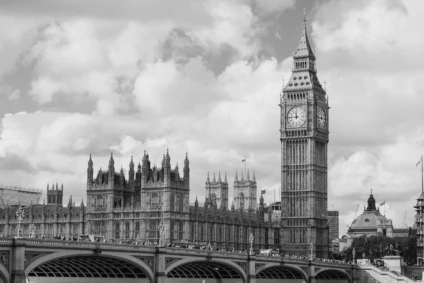


Earlier this year I was in Westminster where there must have been a meeting of the UK’s overseas territories and Crown Dependencies (and this may have fed a small obsession with flags):
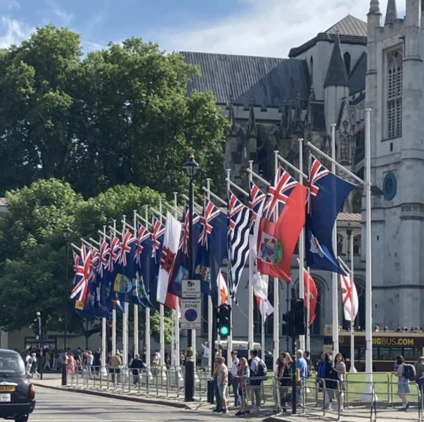
There was a time when nearly a quarter of the world was part of a British Empire that extended across the world, an “empire on which the sun never set”. This is a period of chequered and controversial history this piece will avoid, but the remnants of this empire are fourteen British Overseas Territories (BOTs) that remain under sovereignty of the United Kingdom who are primarily responsible for defence, foreign affairs and good governance oversight. 10 are on the United Nations list of non-self-governing territories.
There are also three Crown Dependencies, closely related to, but not a part of, the UK (geographically, culturally and economically).
| Territory | BOT or Crown Dependency |
| Akrotiri and Dhekelia | BOT |
| Anguilla | BOT |
| Bermuda | BOT |
| British Antarctic Territory | BOT |
| British Indian Ocean Territory | BOT |
| British Virgin Islands | BOT |
| Cayman Islands | BOT |
| Falkland Islands | BOT |
| Gibraltar | BOT |
| Bailiwick of Guernsey | Crown Dependency |
| Isle of Man | Crown Dependency |
| Jersey | Crown Dependency |
| Montserrat | BOT |
| Pitcairn Islands | BOT |
| Saint Helena, Ascension and Tristan da Cunha | BOT |
| South Georgia and the South Sandwich Islands | BOT |
| Turks and Caicos Islands | BOT |
The Crown Dependencies have a population of just over 250,000 and the total population of the BOTs is a bit more than that.
These are relatively small territories and for many businesses not on their commercial radar. From an IP perspective, they are not exactly infringement hot spots. Nevertheless, some global business like to have every nook and cranny of the world covered if they can and so if you have a UK trade mark registration, does it cover the British Overseas Territories and Crown Dependencies? If only there was a straightforward “yes” or “no” answer. The territories all enact their own legislation. We’ll take a mishmash tour.
Yes – UK TMs provide protection
The UK Trade Marks Act has been extended by Order to the Isle of Man, including International Registrations designating the UK. Uniquely, this is an Order of the UK Government, rather than the Isle of Man Government, but it should have been made with their consent. This also allows a Manx company to use a UK trade mark to access the Madrid Protocol (International Trade Mark system).
There may be Registries, but there is no Trade Marks Registry in the Isle of Man.
UK trade marks extend to the British Indian Ocean Territory providing they are not restricted to only a part of the UK. This territory is due to be handed over to Mauritius.
Falkland Islands legislation provides for protection of UK trade marks too.
Yes – comparable UK TMs or UK designations of International Registration provide protection
Legislation enacted in Gibraltar provides for the protection of comparable UK registrations (those cloned from EU trade marks when Brexit happened) and International Registrations designating and protected in the UK. Furthermore, a Gibraltarian business can use a UK trade mark to access the Madrid Protocol.
Yes – UK designations of International Registration provide protection
The local legislation provides that International Registrations designating and protected in the UK provide protection in Jersey.
Jersey is expected to introduce its own independent trade mark legislation in due course.
No – but Cypriot TMs provide protection
While UK registrations do not cover Akrotiri and Dhekelia, these Sovereign Base Areas are completely surrounded by the Republic of Cyprus and Cypriot trade mark law applies with final authority lying with the Supreme Court of Cyprus. The law is effectively a copy-and-paste of the Cypriot law with EU provisions removed as the bases are outside the European Union. As such, EU trade marks should not provide protection.
No – but you can ‘extend’ a UK TM to provide protection
If you cannot protect your mark in Gibraltar and/or Jersey by the routes available above, yet you have a national UK registration then it is possible to extend/re-register this to Gibraltar and/or Jersey by making a local application that takes the same details as the underlying UK registration. These applications are inexpensive.
This is also the case for Saint Helena, Ascension and Tristan da Cunha. Although the latter two islands are legally separate, they recognise the trade marks law of the larger Saint Helena as their trade mark legislation too. Randon quiz knowledge: Tristan da Cunha is the most remote inhabited island in the world.
In Anguilla and Montserrat, it is possible to extend a UK registration too. However, independent registration routes are also available if you do not have a UK registration.
No
The British Antarctic Territory (disputed or not recognised by many countries) has no trade mark legislation – and also no permanent inhabitants (just seasonal scientific personnel). You can register births, marriages and deaths there, but not trade marks.
The Pitcairn Islands also have no trade mark legislation. However, they apply the Common Law of England meaning that it should recognise passing off rights.
South Georgia and the South Sandwich Islands should be in the same position as the Falkland Islands above as there is a Trade Marks Ordinance providing for protection of UK trade marks. However, no notice appears to have been published to bring this Ordinance into force. As such, older Falkland Islands legislation that allowed for extension of UK registrations (which applied to South Georgia and the South Sandwich Islands at the time) is technically in force but unworkable given it has been repealed in the Falkland Islands and there is no longer a Trade Marks Registry there. Nowadays, South Georgia has no permanent population. Even when it did, it was tiny and so not a practical issue. I don’t believe even brands suitable for its inhospitable climate were that concerned about securing protection.
No – go it alone
Bermuda, the British Virgin Islands, the Cayman Islands, the Bailiwick of Guernsey (which for trade mark purposes also includes the legally distinct, Alderney and Sark) and the Turks and Caicos Islands require independent local applications.
It is possible to designate, or subsequently designate, Guernsey within an International Registration. Bermuda’s recent new trade marks law contains provisions related to the Madrid Protocol; the UK would need to extend its membership to Bermuda as it is responsible for its foreign relations.
In conclusion, the trade mark protection routes available for these territories are contrasting.
If you need help obtaining and protecting your trade marks in far flung parts of the globe - or closer to home - please reach out.
Related

Hold the .phone (in your domain portfolio)
- Telecoms
- Tech
- Domains
- Brand Protection
- Trade Marks

When does a restomod stop being a Porsche?
- Automotive
- Trade Marks
- Brand Protection
Formerly Twitter prevails against Twitter.new
- Tech
- Trade Marks
- Disputes + Litigation
Suriname to introduce service marks
- IP Basics
- Trade Marks