



The High Court’s decision in Abbott v Sinocare examined the standards for assessing the validity and infringement of non-conventional intellectual property assets, specifically 3D trade marks.
Facts
The claimant, Abbott, is the market leader in the manufacture of continuous glucose monitoring systems or CGMs. CGMs are typically used by diabetic patients (as prescribed by healthcare practitioners), athletes, and non-diabetic people who wish to monitor their glucose levels (which the court refers to as “wellness consumers”).
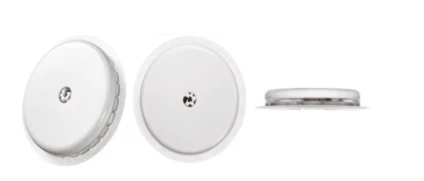
On 30 December 2022, Abbott successfully registered a three-dimensional UK TM No. UK00003779922 in class 10 for “Sensor-based glucose monitors; continuous glucose monitoring systems”. The 3D mark, shown below, represents the OBU (or “on-body unit”) that houses the sensor component and transmission electronics used in Abbott’s CGM FreeStyle Libre product line. It is worth noting now, as this will be relevant later on, that Abbott’s 3D mark was registered on the basis that the 3D mark has acquired distinctiveness.
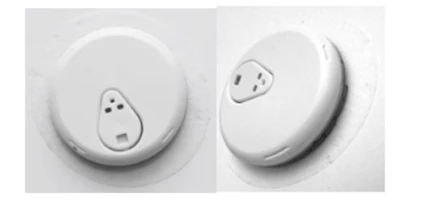
On the other hand, the defendants, together referred to as Sinocare, manufacture diagnostic test products, including CGM systems, for chronic diseases. In 2023, Sinocare introduced its own CGM system, called the iCan i3 (shown below). Sinocare first introduced the iCan i3 to the Chinese market where Abbott also operates before officially entering the UK market in January 2024.
Issues
Abbott claimed that Sinocare infringed the 3D mark on two grounds, namely:
- S10(2)(b) – likelihood of confusion, and
- S10(3) – reputation
In addition, Abbott also advanced a passing-off claim.
In turn, Sinocare counterclaimed against Abbott for the invalidity of Abbott’s 3D mark on two grounds, namely:
- S3(1)(b) – non-distinctiveness, and
- S3(2)(b) – consisted exclusively of characteristics necessary to obtain a technical result.
The court also explored Sinocare’s s11(2)(b) defence to the infringement claims brought by Abbott.
Judgment
Invalidity
Aside from marketing materials, Abbott relied on two surveys as evidence which were criticised by Sinocare given how the surveys were framed to start with mentioning diabetes related questions. The court reminded us that survey questions should be properly “funnelled” and framed to avoid respondents being primed and led into speculation.
Although the survey evidence indicated that consumers were able to recognise Abbott’s OBU, the court noted this does not mean that respondents understood that any white, circular OBU comes from a particular manufacturer. Along with this, Abbott’s marketing materials presented the mark as a product, emphasising its functionality and smaller size. When Abbott’s 3D mark is used in combination with Abbott’s other traditional marks, the traditional marks carry the burden of badge of origin as consumers simply regard the shape represented by the 3D mark as a characteristic of the product.
Therefore, Abbott failed to educate its consumers of the 3D mark’s secondary meaning, leading to consumers failing to perceive the product’s shape alone as a badge of origin. The court held that despite being registered on the basis of acquired distinctiveness, Abbott’s mark did not possess distinctive character.
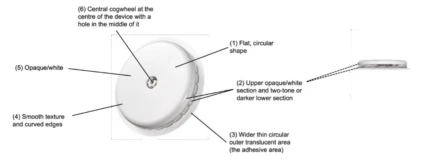
Further to the above, the court decided that of the six identified features of the mark as shown above, features 2 and 5 were not essential features and the rest consist of features which are necessary to obtain the sensor’s technical results.
Therefore, Sinocare’s counterclaims on both grounds succeeded and Abbott’s mark is invalidated.
Infringement
Had the mark been valid, both of Abbott’s infringement claims would have failed due to (1) the high degree of attention of the relevant users who would not be confused as to the origin of the product at the time of prescription, purchase, and usage, as well as (2) the lack of evidence presented by Abbott to establish any likely harm.
Additionally, Sinocare would be able to rely on s11(2)(b) defence to the infringement claim because:
- Sinocare’s sign was inherently non-distinctive, and not used as a trade mark.
Sinocare demonstrated that it was unaware of Abbott’s mark’s existence when they designed iCan i3. No actual confusion emerged. Therefore, Sinocare acted in accordance with honest practices.
Passing Off
In examining the legal requirements for passing off, the court held that:
- Because Abbott’s mark lacked inherent or acquired distinctiveness, consumers did not identify goodwill with the circular shape of the OBU. Therefore, there is no goodwill established for this 3D mark.
- Consumers did not treat Sinocare’s OBU as indicative of trade origin because consumers look for traditional identifiers such as word marks and logos which are featured prominently in Sinocare’s products. Moreover, due to the high degree of attention of healthcare professionals and diabetic patients, they would not be deceived by Sinocare’s use of that shape. Therefore, on either basis, there would be no misrepresentation.
- Due to the lack of misrepresentation, there would be no damage established.
Therefore, Abbott’s passing-off claim failed.
Decision
High Court dismissed the claim for trade mark infringement and passing off arising from the sale of Sinocare’s iCan i3 CGM systems, upholding Sinocare’s counterclaim for a declaration of invalidity of Abbott’s three-dimensional mark.
Take-homes
This case illustrates the importance of having intentional brand marketing.
When enforcing non-conventional marks, such as 3D marks, trade mark owners should be well-advised as there usually is a high evidential burden and fact-specific assessment to enforce these types of marks. Even if a non-conventional trade mark is successfully registered with the IPO, this does not necessarily mean that the mark will be valid and enforceable.
Based on this case, it appears that the court is still of the view that protecting the shape of products through registered TMs is challenging as consumers rarely perceive shape alone as an indicator of origin – especially where the shape is used in combination with conventional TMs (like word marks and logos), as in those circumstances the traditional marks will bear the burden of the badge of origin. Trade mark owners of non-conventional marks should educate consumers to their mark’s secondary meaning by drawing attention to what consumers should be paying attention to, and making sure that these features that they highlight are not features that are necessary to the technical function of the product.
Finally, this a reminder of best practice approach to evidence and observation of procedural rules around the use of survey evidence in a trade mark context, bearing in mind the Whitford Guidelines. When using a survey as evidence, extra scrutiny should be paid to the sample size, framing of questions, and order of questions to prevent respondents from being primed or led into speculation and avoid the possibility of creating bias that negates the use of survey as evidence.
Related

Mind the Gulf - Free Trade Agreements
- Trade Marks
- Designs + Copyright

Got an EUTM, got Europe
- Trade Marks

ELON v ELTON: I’m still (not) standing
- Trade Marks
- Creative

Fame comes with a price (of being descriptive) – GEORGE ORWELL trade mark dispute
- Arts & Entertainment
- Celebrity
- Trade Marks
- Designs + Copyright