



The Supreme Court has ruled on Iconix v Dream Pairs and found:
· for trade mark infringement, post-sale factors can be considered when determining if there is a likelihood of confusion; and
· that the Court of Appeal was wrong to overturn the first instance decision of infringement.
Background
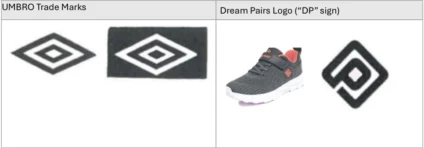
Iconix Luxembourg Holdings SARL (“Iconix”) owns the well-known sportswear brand UMBRO and associated registered trade marks in the logo. Dream Pairs Europe Inc and another (“Dream Pairs”) sell a variety of footwear with the "DP" sign on in the UK via Amazon and eBay.
Iconix brought an action against Dream Pairs for trade mark infringement of the UMBRO Trade Marks under s.10(2) and s.10(3) of the Trade Marks Act 1994.
At first instance, the judge made the following findings when coming to the conclusion that there was no infringement:
· “a very low degree of similarity” between the UMBRO Trade Marks and the DP Sign; and
· no likelihood of confusion.
The Court of Appeal overturned the first instance decision on the basis that, the findings in relation to the degree of similarity were irrational when the DP sign was not viewed straight on, as would often happen when someone was wearing football boots. In assessing similarity and confusion itself, the Court of Appeal found that there was a likelihood of confusion because in the post-sale context, there was a "moderately high level of similarity". Dream Pairs appealed to the Supreme Court.
Supreme Court Decision
The Supreme Court has unanimously allowed the Dream Pairs appeal, but rejected the arguments that post-sale confusion cannot be taken into account in order to assess similarity.
The decision sets out that: “realistic and representative post-sale circumstances can be taken into account for the purpose of establishing whether the signs at issue are similar and, if so, the degree of similarity.”
Also of note, the Supreme Court held that: “marketing conditions counteracting any similarity will be taken into account in the global assessment of the likelihood of confusion.”
The Supreme Court also held that the Court of Appeal was not justified in its finding that no reasonable judge could have reached the same conclusion and overturned its decision on similarity.
Takeaways
This is a positive decision for the owners of registered trade marks, as it provides guidance on how post-sale confusion evidence will be incorporated into the assessment of similarity.
This decision is also a good reminder to those in court proceedings of the difficulty with establishing on appeal that a finding made by a trial judge was irrational and therefore should be overturned.
Related
Hold the .phone (in your domain portfolio)
- Telecoms
- Tech
- Domains
- Brand Protection
- Trade Marks

When does a restomod stop being a Porsche?
- Automotive
- Trade Marks
- Brand Protection
Formerly Twitter prevails against Twitter.new
- Tech
- Trade Marks
- Disputes + Litigation

Suriname to introduce service marks
- IP Basics
- Trade Marks